
To The Point with Doni Miller
The Dorr St. Project
Special | 26m 27sVideo has Closed Captions
Robert Smith and Doni discuss the broader conversation unfolding around Dorr Street.
The Dorr Street development project. City leaders call it progress, but some community members are raising concerns. Resident Robert Smith and others are asking whether the process has been transparent, whether neighborhood voices are being heard, and who truly benefits from the proposed changes. Is this redevelopment revitalization—or something else entirely? It is discussed on this episode.
Problems playing video? | Closed Captioning Feedback
Problems playing video? | Closed Captioning Feedback
To The Point with Doni Miller is a local public television program presented by WGTE
To The Point with Doni Miller
The Dorr St. Project
Special | 26m 27sVideo has Closed Captions
The Dorr Street development project. City leaders call it progress, but some community members are raising concerns. Resident Robert Smith and others are asking whether the process has been transparent, whether neighborhood voices are being heard, and who truly benefits from the proposed changes. Is this redevelopment revitalization—or something else entirely? It is discussed on this episode.
Problems playing video? | Closed Captioning Feedback
Where to Watch To The Point with Doni Miller
To The Point with Doni Miller is available to stream on pbs.org and the PBS app.
views and opinions expressed in to the point are those of the host of the program and its guests.
They do not necessarily reflect the views or opinions of WGTE public media.
Hello and welcome to The Point.
Today we're taking a closer look at the community reaction to the proposed Dorr Street development project.
While city leaders describe the project as a catalyst for growth and revitalization.
Some community members are asking harder questions about its impact.
Among them is Robert Smith, executive director of the African American Legacy Project, who, along with other residents and stakeholders, has voiced concerns about transparency, neighborhood impact and whether the proposed benefits will truly reach those who live and work along the corridor.
Is this development the right fit for the community, and is the process earning public trust?
Well, today we examine those questions and the broader conversation unfolding around Dorr Street.
I'm Doni Miller, and welcome to the Point Connect with us on our social media pages, and you know that.
You can email me at Doni Underscore Miller wgte.org for this episode and any other additional extras go to wgte.
org to the point we have with us today.
Our guest, Robert Smith, who's the executive director of the African American Legacy Project, but also, one of the primary voices in the discussion, the recent discussion in some ways, in other ways, it's been a long, long term discussion about the revitalization of Dorr Street.
And there is a little bit of back and forth around what the city should be doing in regard to that, revitalization given their recent acquisition of, of the race grant.
So I'd like to talk to you today about, since you are one of the major voices, among those expressing community concerns, I'd like to talk to you a bit about where those concerns come from.
Why now and what it is you hope to get at the end of all of this.
So let's put some context to this for our audience.
The the community has applied for.
The city specifically has applied for and received a raise grant.
Is that correct?
And that grant, proposal included improving the infrastructure safety, mobility and connectivity of areas of the city where residents need it most is what's in the proposal.
The city has chosen the Uptown neighborhood and the junction neighborhood in which your organization sits at Inglewood and Inglewood.
Thank you for that.
For the project.
Sounds great.
Hey.
What's great?
What's your.
Sounds great.
We were involved in this very early in the process.
Consultants and everything, you know, immediately we had questions because we wanted to understand what the is.
Grant was.
Contrary to popular belief, some people out think that we don't understand that this is an infrastructure grant.
It's clearly an infrastructure grant.
And it's really just positioned perfectly for, these communities, which they've targeted.
It.
Early on, the questions were some of the key selling points were, the ability of young men and women to, ride their bicycle from for a bike path from their neighborhood just in Inglewood, and then turn around and end up at the William and Palmer y whether it was, the mayor, the winner of the heat in summer and bypass the Frederick Douglass Center who had the same or similar, services.
So, you know, then the other point was, you know, there were many complaints about, you know, that Patton led the league people from the community to opportunity, you know, thinking that we've not had that same opportunity within the context of the community.
So there were just a number of questions that we raised over time.
In fact, it's been about 2 to 2 and a half years where we've had the same as some of the discussion.
So it just, didn't sit right.
So we wanted to go and learn more about what the grant capability was.
And so that capability is, is to use infrastructure to, to make, a community such as our community, at the junction, Inglewood.
And we're focused on the historic district, which later was made that developer ready and investor friendly and, and begin to change this narrative about who the African-American community is.
It's been 16 years since 60 years, nearly 16 years since the city made, incredible promises about you know, redeveloping, the doors to business district.
The race grant is right in front of us right now.
The last, last major, funding opportunity was port side, and and neighbors signed off on developing port side, and those promises were there 60 years later.
Port sites not there, but the neighborhood is sort of still standing.
Very fragile.
Yeah.
The last dollars came in was those Arpa dollars and Biden dollars.
We didn't we didn't benefit from that either.
And now go ahead.
No place finish.
And now the race grants it squarely in front of us.
If you go to the city's website, you see the executive summary, which totally outlines who the grant is supposed to benefit.
Our question is, did we get left behind?
And if we got left behind, why did we get left behind?
And how can w rectify that?
So your position, if I might infer from your comments, is that the community has been left behind in this discussion.
Fortunately, there's a $53 million award, or at least with the match.
And of that $53 million or less, $10 less than 3% or approximately around 3% will go into an A neighborhood.
It's about $700,000 of that grant, $53 million will travel elsewhere.
That you know, you can say that maybe the city didn't understand, but I invite anybody to to go to the internet and look at something called mending broken promises of Door Street and High city officials talk about really understanding that.
So I read that.
So we really need to.
Go at it.
So so I think that the the concern or the questions that seem to arise that are contrary to your position have to do not with whether your position is appropriate.
I think that everyone would say city council, the mayor.
I've not spoken to any of them about this, but I did read an interview.
That the mayor gave on the import in 2024.
In fact, on the importance of of revitalizing the Door Street corridor.
I think that they would say that this this is not the vehicle to do that.
And I've heard you say that this is, in fact, the vehicle that is actually the perfect vehicle.
If you look at.
You know, 70%, that neighborhood or the two neighborhoods represent African-Americans, fully 28% of African Americans, the population is African American, yet only 17.5% of that district, it represents a tax base.
That alone just shows you the decline in disinvestment, right?
That we can't continue this.
You know.
So let's talk about that.
Let's talk about the decline in, and the disinvestment in the neighborhood.
The conversations that I hear, around and about sound, as though you think it's intentional or do you think it's a neglect?
Well, if the grant was written on the basis of the neighborhoods, they certainly are aware of the plight.
Okay.
At one point, there was a blank piece of paper.
And decisions were made.
The consequence of that is we're still in the same position.
Or maybe worse, the socio psychological impact.
I mean, you know, no businesses, no tax base, no opportunity for generational wealth.
How much longer do we have to acquiesce, to being I don't want to use the word to being marginalized, if you will.
It just perfect time to grant was written.
There is purpose is purpose is in front of us.
There's no way that we shouldn't have that opportunity.
I mean, we look at it as though, I'll say it in this manner, the African American community may not be a high priority.
60 years.
We'll give you that opinion.
And I think for people who I think for people who, are looking at this issue, if I, if I may, who are looking at this is as a singular instance, what I hear you saying is that this has been from your perspective.
And those who who are with you on this issue, this has been a 60 year process of disinvestment.
Ask any government official, make sure we like, chat, recite chapter and verse the story of Door Street.
And that is exactly where I was going.
Thank you for taking us there.
We've got two minutes left.
Tell us a little bit about that story.
Very simply.
We were in a meeting with, several city officials and, they were telling me about the disinvestment.
And I said back to them, okay, this is the part of the story that I don't have to tell.
The community, across community, everyone is very, very aware.
And because of that, you know, there's an elevation, there's a core not there.
It's not just about Robert Smith.
Let me be clear about this.
We have we have car trains of people now meeting.
We we are meeting in the churches now, and particularly we're meeting historic churches.
Such that we have the ability to, they are institution, they are profoundly gifted, and they have led us all the time.
And and what we're doing automatically, we're trying to create we're trying to demonstrate to whoever, particularly inside the community, particularly outside the community, that.
We've had a community that works for life.
That's right.
That's right, that's right.
We are going to start at that point when we come back, because that is an important description in this conversation.
You're going to stay with me, right?
We will be right back.
To me, community means connecting to others.
I'm Doni Miller and welcome to the Point.
I love PBS kids.
We're a community committed to education.
Discover new ideas, dive into exciting subjects, and engage with the world around you.
I would send them personally a t shirt.
Crime doesn't pay in the old West End.
Pass it on.
That's how we cleaned up the neighborhood.
Vision loss for people is not the end.
It's the story.
It's the next chapter.
WGTE Public media invites you to get out and play day.
Monday through Friday.
It's the 419 powered by WGTE with Matt Killam, Gretchen DeBacker, I'm Kevin Mullen.
What can people expect on the show?
Give me an hour.
A reminder of why this is a great place to live, work and play.
Where you come to watch, listen and learn.
Connect with us on our social media pages.
But you know that you also know that you can email me at Doni underscore Miller at wgte.org.
I really love hearing from each and every one of you.
For this episode and other additional extras, go to wgte.org to the point we are speaking, in the second segment of our show with Robert Smith.
Mr.
Smith is the executive director of the African American Legacy Project and one of the primary voices of a community concerned that they are being left behind and that the city in its recent acquisition of the race, grant is not quite hearing.
What they have to say.
Is that a fair assessment of where you are?
When we went to break, we were talking about the door Street that that that was an example of why the community is so insistent on the city hearing about ways to, to use, the race grant for revitalization.
You know, I'm a product I'm a product of that area, at 18 years old, 18 years old.
I was working in a place called Clarks Record Shop.
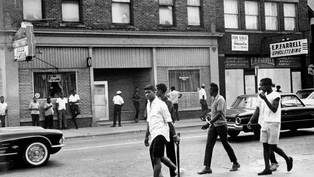
There, you know, I'm overjoyed to to one of the 25 and our bad, little bad, the, but all of our business men and women who taught me being on time, who taught me, you know, the importance of business, who showed the little profit centers that they would create inside the business, who, mentored and, and also, chastised me and others, you know, it was a real community, alive and well, the bar club, the model.
And there was a two brothers on it, Mayweather Hardy sat in his bar and played chess with everybody who watched.
Mr.
Hardy was Mr.
Word business suit every day.
This guy blossomed.
Not too far from him was, Billups, Appliance Center, which turned into the black appliance, into Mr.
Bell.
You talk about generational wealth.
Mr.
Billups took that, and you walked into his shop and you saw, he made appliance repair, but he also you saw use and new appliances in there for sale.
He made out, I mean, this uniform individual.
And to think that young men and women who were under 40 have no idea about business principles, about African-Americans, a generational wealth, about, the efficacy of owning your own or about, sharing or about, you know, dignity and humanity among ourselves and those, those two things, the dignity, dignity and humanity that, pretty much the same principle that we are asking us to see in terms of potentially redeveloping this area.
You can't have it two ways, people.
Just a few months ago, people were talking about the snap program and ensure Snap program was always meant to be temporary.
We've seen that continue to subsist, that kind of federal welfare.
We have the ability, we've had the creativity.
We have the opportunity to build something to sustain community and contribute to a tax base, to be live and in living color, if you will.
It's really incredible to me that, 60 years later, we're still talking about the same thing.
Are there examples in other cities of this conversation going on?
Oh, Detroit to a place called Black Bottom, you know, much, our larger Door Street, it's now called Paradise Valley.
Columbus has, the King Lincoln district, which we took a busload of people there, which is amplified and matter of fact, we were lucky enough to get one piece, from.
But it's a mural.
As you enter the gateway into the city, people who contribute to African Americans who contributed significantly to the community.
So we were lucky enough to get that piece.
And there's also, Kansas City Jazz District.
It is amazing.
There you have it.
What that demonstrates you in Kansas City is about to do Kansas City Jazz District three.
They're expanding.
The opportunities are there.
We are talking about creating this, reframing the district, branding the district as the Art Tatum Historic Business District.
Obviously, we're talking about reaching beyond, the community.
This is not just a community project.
One of our first initiatives.
And we had started this, about before.
Was that sidetracked on getting involved and trying to ensure that the race track, there was some equity in the, for the community in the, in the raise grant, which we had.
But experts from Ohio State who talked about Art Tatum, we want to do an international piano competition bringing cultures together.
We can see the International Institute and others, housing young men and women who can see parents and others connecting.
And we can see government agencies, even if we talk about economic growth, having the opportunity to reach into these, the to put Toledo out front, a very easy mechanism.
It's not just about this community.
People have this lopsided view, why we're doing what we're doing.
But we understand, you know, that in order to be of importance to ourselves, we have to be of importance to others.
We have something here.
We talk about cultural assets.
So if if the if elected officials persisted their position that this particular, financial opportunity is not appropriate for what you and other community members are suggesting, are you open to continuing the conversation and looking for another vehicle?
We're always open to continuing conversations, but hopefully that continuing conversation will be about the race.
Quit, right?
If we were not to be included, you should not have put us so prominently in that grant you the grant is to distinguish disadvantaged communities, and disinvestment.
And they talked about the city talked about in the whoever the writer was about the I-75 community turmoil and on and on other.
Well, if you don't think this is the right time, why did you use us?
No, I don't think that we I think that we should we have to look for additional opportunities.
But I don't think that.
I don't think that our community to weather another storm 60 years from now, people who really care and understand what happened won't be in place.
And we've been, made a priority.
Now, if there's no one talking about it 60 years from now, there is no priority.
So for me, it's, the grant is here and it's present, and it's not too late to change.
We know that.
Well, look, we've looked into, federal regs to know that, you know, in this particular planning stage, there's opportunities to, make adjustments.
And that's all that is, engineering and otherwise.
We're not asking the city to change someone, though.
We we sometimes get, challenged because we don't quite understand what the grants capable of doing.
We have finally, do we want to look for developers?
We want people to come in and go.
We want to start doing things in the community.
And we are now I need to show you.
That's one of the reasons why we're working in the churches.
We hold a meeting in the historic churches.
Last month the we held one in Third Baptist.
And as a result, there are Baptist.
We are now creating the pipeline.
October 3rd weekend, October 3rd.
We're bringing Central State University here to create a pipeline between the Toledo community and Central State.
To go forward from now on, that take time up and recruit.
And that's I was talking to the young, athletic director, everybody.
He's young compared to me.
She said, you know, Mr.
Smith, he he'd be happy to know.
We just concluded three kids from state high school.
So we want to reinforce that.
And not just high school, but the entire community.
And I was talking to the new minister at, point and me telling him about the success of what we're going to do with that center of state.
He says, well, you know, Wilberforce is our school.
Well, pastor, let's get started so we can do thanks, then.
Do you think that we should know that we can do things and we don't have to necessarily be absolutely dependent?
We want to demonstrate, to others and to excel.
That brings, that brings me to a point that I wanted to make sure to, to raise with you.
There was an editorial in the blade, in response to, the group, sort of pushing back and questioning, the race grant.
And one of the statements in that editorial was and and it was overall, I think, was generally supportive of the notion that reinvestment needed to occur along the Door Street corner.
But it said, as I recall, that the community needs to seed new businesses.
And did you read that the purpose, that that's the purpose of the race.
Okay.
So let's going to ask your response to the editorial.
And, the newspaper did invite me to respond, but, some of the things weren't so accurate.
So I didn't see a need to defend, a position that wasn't correct.
So we just left that alone.
However, someone else, wrote one, too.
And, to to counter what transpired.
But, you know, the public discourse is not where we need to be.
And we kept discussions tamped down inside the community.
How would you suggest changing that in that couple of minutes?
We have left?
And is it important to change that?
We're going to open up the door.
We'll open up the door.
All right.
It's time.
The city.
I'm not calling the crisis, but you know.
Oh, outsiders, if you little if you look at from inside out, you know, we have nothing.
But here's the opportunity and, you're telling us, let's look for some other dollars.
Those dollars.
These dollars, really are life changing.
And the city understands that.
There's no question that the city understands it.
I just think the, Felt comfortable and maybe not.
Maybe folks are seeing the dollars elsewhere.
I don't know if the need is greater.
I doubt it.
You can't go there.
You can't go into any other neighborhood and see the devastation.
We are here to work with the city in any capacity necessary to do this project, to get this done.
This is an important conversation and we obviously need to have it again and again and again.
I'd like to thank you for joining us today for this important conversation.
And I look forward to seeing you again.
On to the point.
Enjoy your day.
Announcer 1: The views and opinions expressed in to the point are those of the host of the program and its guests.
They do not necessarily reflect the views or opinions of WGTE public media.
Announcer 2: To the point is supported in part by viewers like you.
Thank you.
Airs Friday, April 17th at 8:30 p.m. and repeats Sunday, April 19th at 11:00 a.m. (30s)
Providing Support for PBS.org
Learn Moreabout PBS online sponsorship New Episode
- News and Public Affairs

Top journalists deliver compelling original analysis of the hour's headlines.
 New Episode
- News and Public Affairs

Today's top journalists discuss Washington's current political events and public affairs.
 New Episode
 New Episode
 New Episode
 New Episode
 New Episode
 New Episode
 New Episode

 New Episode
 New Episode
Support for PBS provided by:
To The Point with Doni Miller is a local public television program presented by WGTE