
To The Point with Doni Miller
The Anthony Wayne Fire of 1961
Special | 26m 25sVideo has Closed Captions
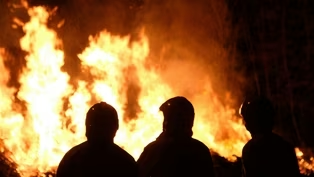
Joe Walter discusses the gasoline tanker explosion on the Anthony Wayne Trail, June 10, 1961.
No other fire in the city's history has claimed the lives of more firefighters than the gasoline tanker explosion on the Anthony Wayne Trail, June 10, 1961. On this addition of To The Point, we honor those who, in the midst of chaos, showed courage and strength rarely witnessed. Doni's guest is Retired Assistant Fire Chief and Past President of the Toledo Firefighters Museum, Joe Walter.
Problems playing video? | Closed Captioning Feedback
Problems playing video? | Closed Captioning Feedback
To The Point with Doni Miller is a local public television program presented by WGTE
To The Point with Doni Miller
The Anthony Wayne Fire of 1961
Special | 26m 25sVideo has Closed Captions
No other fire in the city's history has claimed the lives of more firefighters than the gasoline tanker explosion on the Anthony Wayne Trail, June 10, 1961. On this addition of To The Point, we honor those who, in the midst of chaos, showed courage and strength rarely witnessed. Doni's guest is Retired Assistant Fire Chief and Past President of the Toledo Firefighters Museum, Joe Walter.
Problems playing video? | Closed Captioning Feedback
Where to Watch To The Point with Doni Miller
To The Point with Doni Miller is available to stream on pbs.org and the PBS app.
The views and opinions expressed into the points are those of the host of the program and its guests.
They do not necessarily reflect the views or opinions of public media.
No other fire in the city's history has claimed the lives of more firefighters than the gasoline tanker explosion on the Anthony Wayne Trail, June 10th, 1961.
Deputy Chief Ewald Bode, veterans Glenn Carter, William Jensen and Robert Harrison would pass in the days and the months following the inferno.
69 total firemen dispatched on the three alarms.
80 would ultimately be injured, including 38 children and 12 firemen.
You are alive today.
Those are the opening words of a documentary on the worst fire in Toledo's history.
On this edition of To the Point.
We honor those who, in the midst of chaos, showed courage and strength rarely witnessed.
Our guest is retired assistant fire chief and past president of the Toledo Firefighters Museum, Joe Walter.
This is to the point.
I'm Doni M Connect with us on our social media pages.
And you know that you can email me at doni underscore Miller at.
wgte dot org And for this episode and other additional extras, go to.
wgte dot org To the point we have Joe Walter with us today.
You will be very interested in the story that Mr.
Walter has to share with us today.
Mr.
Walter is a retired assistant fire chief, former public safety director for mayor Jack Ford, past president of the Toledo Firefighters Museum and your current member of that board.
You've been a busy guy in your career.
Yeah, I have enjoyed my career greatly.
Being a fire department, we served the people and we work hard together as a community and as teamwork on the job.
So it was a great, great career for me.
You know what one of the things that I love about what we're going to talk about today, which is one of the the worst fire, not one of the but the worst fire in the history of Toledo and and the Toledo firefighters.
One of the things I love about this story is that it reminds people how essential the work of fire departments are and what brave, brave people serve in that capacity and serve this community all the time.
So I thank you so much for bringing this story to us.
Normal Day in Toledo, June 10th, I think the day it was 1961.
What happened?
So about just about 11:00, an alarm came in.
This gasoline tanker had crashed on the Anthony Wayne Trail, and I caught fire.
And immediately the crews responded and they got there.
It mushroomed and grew so fast that it got out of control.
And just as the firefighters were there setting up to cool the tank down, it blew up with a huge, huge fireball.
When I talked to people, I didn't didn't live here at that time.
And it's not prominently anybody on the department today who was even alive then.
And when you talk to other people that were around, they remember what happened and the whole community just was it was it was a big crisis for firefighters were killed, eight others injured, some critically, 80 people altogether, including civilians and a police officer were injured at that fire.
It was, we call it, the deadliest fire in terms of firefighter casualties that we ever had.
Yeah, I think that one of the things that and I'm going to mention this a few times during our time together, people really need to take a minute to see the documentary in order to get the the total scope of what devastation occurred that day.
The documentary is called Trail of Fire of 1961 Toledo Firefighters deadliest disaster.
It's worth, it's worth the look.
One of the things that I saw in that documentary was that once there was the explosion, balls of flame flew for blocks.
It's hard to for most folks to understand.
Even for me as a firefighter, there was two tanks on that.
Excuse me, on that truck, two 4000 gallon tanks of gasoline, and one was a trailer behind the main truck.
And when you probably 25,000 pounds of weight on that on that trailer and it took came in that curve off the trail, the exit trails, it was then in the back tanker overturned, slid by the first one and gasoline spilled, and then they were off to the races.
And that when you see that fire, if you look at the documentary, it is a great big fireball and there's so much fuel that it that it just blows up at starved for oxygen.
And people who are in the community can say, I can still remember seeing that, you know, I mean, I went to the fire, which was a big fire.
Nothing compared, nothing like this, nothing like this.
And the interesting thing was, the first of all, it's important to note that the trail is no longer configured the way it was in 1961, and that's in large part because of this fire.
It was that and also because of I-75.
I-75 was not built yet built, I think late 60s.
And the trail itself used to be the Miami Erie Canal.
And they filled it in in 1930 and made a highway out of it.
And they kept the same path for the roadway as the canal boats did back in the day.
They ended up by Swan Creek.
And actually there was a lock there that raised the boats and lowered the boats to meet the Swine Creek compared to the height of the canal.
And that contributed to the fire as well.
Big sweeping curve and incline.
So the speed picked up, you know.
So I think the cause of the fire was 2 to 2 fold.
One was was the the design of the truck.
They never was a bad design.
The design of a highway, which was used to be a canal and it and probably some speed and.
Yeah.
And there had been accidents before that and accidents after.
I mean, it it truly was a troublesome point in the road.
One of the things that I read was that the fire was so intense in this particular story sticks in my head.
The fire was so intense that a little boy playing baseball.
Did you did you hear that story?
Had his back burned.
There's a picture of him at the mound.
Had his back burned very, very badly as a result of that fire.
And he was blocks away from the fire.
There's so much heat.
And it also burned the clothing off the firefighters who were there.
And in those days, if you can believe this, Donny, were rubber boots and rubber coats to fight fires.
Couldn't keep the water off him, but didn't protect you very much from heat.
And some of those they melted.
It was just when I first got on the job.
They said, remember the trail fire.
Always button up your coat and pull up your boots and all that kind of stuff.
But today the protective clothing is so much better.
But it was enormous fire, so intense.
It was melting the the rubber clothing.
Yeah.
Rubber clothing.
Wow.
Was were there any houses lost any damage in the neighborhood?
So.
Right just past where the fire blew up the dead end of Vinton Street, which comes from south Toledo to the about three houses caught on fire there, and it spread to there.
And there's a there's one of the folks, one of the firefighters who was killed.
The store that goes with that.
His crew member came to the fire scene and said, chief, what do you need?
And chief said, I want you to go get this nozzle and say, he went to get it.
And while he was getting the other crew had it.
And he went, the chief, they've got the knowledge.
What do you want me to do now?
And he said, I want you to go up on this, this street and Vinton Street, and I want you to check out because it's probably going to, you know, extended there.
And as he went up that hill, the thing blue, he was saved by the way the blast went.
But his crewmate, his driver, had to stop and put his finger on before he got to the fire.
And he got the brunt of the blast.
It was just so many stories like that.
Just by seconds.
Some people survived, some didn't, you know?
Yeah, there are so many civilians ran in to help, which I was amazed at because there's fire everywhere.
There are people hurt everywhere.
And there were people running to this event to help.
Some of them were were just to watch, some to help.
You know, if there's in the film, there's a bridge or old railroad bridge where people were observing the fire.
Right.
And if the fire hadn't gone the other way, it would have taken them all out.
I mean, it's just the force.
The blast went towards the mommy River instead of going back the other way.
So it was.
It's extreme tragedy.
And I we show this documentary in 2024, and before we got it through, we'd had a visit from one of the families.
I go back during this time and looking at the families who came and this person was a casualty.
He didn't die, but he they came in and he had bandages wrapped all around his hand, around his head, and we showed it to them, the family, privately.
And at the end of the documentary, I mean, it was it was just a small group of us.
There wasn't a dry eye in the house.
And when we first premiered the documentary, we did the Imagination Station at the end.
People were so dramatic they didn't know what to do, whether to laugh or cry.
And because it was so dramatic, you know, it is an amazing documentary.
It's really worth seeing.
For those of you who are interested, it is called, again, The Trail Fire of 1961 to Toledo firefighters deadliest disaster.
It's about 27 minutes and it is very, very much worth your time, especially if you are interested in firefighters and fires and this enormous piece of history.
We are actually going to go away for just a second.
But when we come back, I'd like to talk about why this is important to remember and the memorials that the memorial and the memorial that you, that the museum actually sponsors.
Okay.
All right.
You'll stay with me.
All right.
We will be back in just a moment.
To me, community means connecting to others.
I'm Doni Miller and welcome to the Point.
I love PBS kids.
We're a community committed to education.
Discover new ideas, dive into exciting subjects, and engage with the world around you.
I would send them personally a t shirt.
Crime doesn't pay in the old West End.
Pass it on.
That's how we cleaned up the neighborhood.
Vision loss for people is not the end.
It's the story.
It's the next chapter.
WGTE Public media invites you to get out and play day.
Monday through Friday.
It's the 419 powered by WGTE with Matt Killam, Gretchen DeBacker, I'm Kevin Mullen.
What can people expect on the show?
Give me an hour.
A reminder of why this is a great place to live, work and play.
Where you come to watch, listen and learn.
Connect with us.
You know this on our social media pages.
And you also know that you can email me at Doni underscore Miller at wgte dot org and for this episode, in any of the others that you'd like to see, just go to wgte dot org To the point we are talking today with Joe Walter.
Mr.
Walter is, as I mentioned in our first segment, a retired assistant fire chief and lots of other things having to do with the fire department and a current member of the museum.
And we're talking about the horrific fire in June of 1961.
This is this is around the anniversary of that of that event.
So why is this event worth remembering?
So we have a fire service.
The saying that as long as their names are spoken, they're remembered.
Oh, I love that.
Yeah.
And so we after the fire, if the trail fire, the community rallied and built our memorial, which is down across from fire station number one, next to where the blade.
You had their headquarters in triangle called Wolf Park.
And so the community raised funds.
They made the memorials.
So we started having these memorial services on the anniversary of the fire, and includes all 64 people who died in the line of duty since the department was established in 1837.
And so we gathered there to remember, because we don't want to forget.
Right.
And this particular fire was I think it's important for folks to know that it it was such an extraordinary event.
People were taken to Saint Vincent's Hospital, and this fire was one of the reasons that Saint Vincent's developed its extraordinary response to these kind of they developed a burn unit just because of that.
And it wasn't just fees, but it was Mommy Valley.
Every hospital in the city took casualties.
In fact, one of the folks that died, his wife was was pregnant with her child.
She went and delivered the same time he was in that hospital.
Another one of those tragic stories.
Tragic stories.
He was on one floor.
She was delivering on another while he was.
He was dying on the on the floor below.
That was a particularly difficult, particularly difficult story.
So the the memorial service is an annual service.
It's an annual service on or about June 10th.
The only time it changes, if it comes on a weekend and they move it one way or the other, and they read every name.
9:44 a.m.. Of the of the members who died and those folks as well.
And they ring a bell for every name that goes through, and that it brings us together and reminds us how lucky the rest of us lucky we are.
Absolutely.
I get more I could concerned about the families who had to suffer the results of that afterwards.
I mean, they live with those memories longer, you know, forever.
So what lessons do you think the city learned from that event?
Well, I think a couple of listeners that the fire department learned is, is is you you can't trust something like the hazardous material that's in an accident.
You know, actually, there was a training session before this and how to cool a tanker fire down.
It's under controlled circumstances.
And so they tried to do that.
And this was not a control.
It was an accident.
That was the other thing is big improvements and protective gear to save folks.
You know.
Were.
Are you concerned as a department today about people rushing in to help in these in these files?
You know, in the 1980s, they established the big program across the country for hazardous materials.
Incidents can be explosives, it can be gasoline and other things.
And one of the things that we emphasize on the training was, you know, you have to size it up and don't rush in.
In fact, as a commander on the fire scene, I always had some folks that I knew wanted to show how, you know, brave they were.
And those are the ones you had to watch out.
Going back a little bit, you know, but it's we try to do a risk reward, you know, we'll do everything we can to save lives that are we can save we.
But we those that are weighing on those cents go in and committing yourself so you never know what's going to happen on the department.
Every day can be something different and something very dangerous.
I think that that we don't as a community, think about the the risk that firefighters face every day.
We are, I think, more connected with policemen.
We hear more about them.
We see them more as we travel through our daily activities.
But we don't really think much about firefighters until, of course, something's on fire.
And then you're really glad that they showed up.
What would you would you want people to know about the people who choose that profession?
You know, some of them, they want to do it because their friends knew it, but some of them want to do it because they're giving back to the community.
And I will tell you, any major incident that the police are involved in, where they are with them, you know, and so it's together and the risks are become almost the same.
You know, it's but it's a great job.
It's a chance to serve the community.
It's a chance to do something for people, you know.
And that's why I think most people take that job.
Is that why you took that job in a way?
Actually, I was looking looking for a solid job with to raise a family.
Had good benefits.
And it turns out, and I was just back from getting out of the service.
It was the best thing for me because again, I was in that team environment, people looking out for each other.
And I'm so rewarding, you know?
Yeah.
So what would you say to young folks today who were thinking about being firefighters?
Is it is it tough to do?
Obviously it's rewarding to do.
It's a physical job.
But also today, 80% of what we do on the fire department today is related to emergencies, medicine and anything you see in emergency room these folks do on the street.
So they see people who are in problems with with health accidents, whatever.
And so they have to understand that you're there to help people.
And most people, they just they go for it.
The extensive training today though, is there almost like, you know, people working in the air.
And good for them.
Good for us.
Right.
And tell us a little bit about because I know I know what what we are hearing quite often is that there is extraordinary difficulty getting recruits for the fire department and for the police department.
Have you stayed in touch with the requirements for those?
The requirements are higher today, but we have an extensive training program.
If you can learn, you can do it.
It's really isn't for everybody, but it is one of the most rewarding things you ever do.
And their training is lasts almost six months, constant training.
And it's I mean, they read EKGs, they start IVs, they did all this stuff.
And so that's part of it as well.
So that makes it a little more difficult and than the older days.
Yeah.
Yeah.
And women are more present.
Sure.
Yeah.
Absolutely.
Yeah yeah, yeah.
Encouraging women to consider this a viable, viable careers.
Yeah.
We get women who were nurses.
We get women who are just want to be involved in things.
And they can they can do the job and no doubt about it.
Absolutely.
So I want to talk a few more, a few more minutes.
We only have about five minutes left.
And I would like to talk about that day just a little bit more.
When when you realized that or when they realized that this accident, that this accident happened, there were six units.
There were there was a three alarm fire.
Yeah.
Eventually each each fire as it increases, they they raised what they call it, another alarm, which is another complement equal to the first group that came in and say the fire only lasted.
It was over by 118 in the afternoon.
Because how long was that?
About two hours.
2.5 hours and some fires will burn.
This went up on this fast.
You know, the worst of it was that initial explosion.
But they rallied everybody.
They came there.
There's folks that responded and talked about what they saw coming, and they were like, oh my God, look at this thing, you know?
And one guy described the fire as just organized chaos when he got there.
Yes.
And I've got some photos that will look through other people with people looking in the aftermath that looked like, you know, a bomb hit and they're just like dazed, you know, it's so.
And these folks, there's probably only four people that I know of who are related to the fire service, who were alive today or from that fire.
And, you know, they they just shake their head.
And how could this have happened?
You know, they were really surprised the amount of that force.
It was huge.
It was just huge.
Yeah.
And your we talked a bit about the fact that that your memorial is an annual it's an annual memorial.
Is there a way that folks can participate?
Is there a way that people in the community can show their respect and their appreciation?
Maybe it's part of that service or maybe some other way.
Yeah.
Well, for the service, it's open to the public and we encourage folks to come down.
We can't come to our museum.
We'll show you some of the things that happen, and then we'll show you what the job is about to the museum.
Yeah.
It's at 918 West Sylvania, right across Phillips Avenue from Manzini.
So if you're standing there, parking lot, and you look to the north, you'll see our old fire station in 18.
Yeah.
So they can certainly come to the museum.
They can donate.
Oh, sure.
Yeah, yeah.
It's open every Saturday.
It's free.
It's fully supported by the mostly supported by the active members.
They throw a few bucks every every paycheck.
And that sustains the cost for us.
We've had a few larger donations, but most of it's just by the active membership that supports us.
Yeah.
I'm so glad that you were here today to remind us of this event.
I think it's critical that we hold on to memories of people who give their lives in the service of of this community.
It's so easy for us to take it for granted.
And you have helped remind us today that that's something that we shouldn't do.
So I want to remind everybody that the the memorial service is an annual service.
We encourage you to participate in that.
And when you get a chance, go hug a fireman.
They'd really appreciate it.
Thanks so much for joining us today.
On to the point and I will see you next time.
The views and opinions expressed into the points are those of the host of the program and its guests.
They do not necessarily reflect the views or opinions of public media.
To the point is supported in part by viewers like you.
Thank you.
The Anthony Wayne Fire of 1961 promo
Airs Friday, June 19th at 8:30 p.m. and repeats Sunday, June 21st at 11:00 a.m. (30s)
Providing Support for PBS.org
Learn Moreabout PBS online sponsorship New Episode
- News and Public Affairs

Top journalists deliver compelling original analysis of the hour's headlines.
 New Episode
- News and Public Affairs

Today's top journalists discuss Washington's current political events and public affairs.
 New Episode
 New Episode
 New Episode
 New Episode
 New Episode
 New Episode
 New Episode

 New Episode
 New Episode
Support for PBS provided by:
To The Point with Doni Miller is a local public television program presented by WGTE