Connections with Evan Dawson
Inspired to serve by 9/11
9/14/2026 | 52m 5sVideo has Closed Captions
Local veterans reflect on enlisting after 9/11 and what their service means 25 years later.
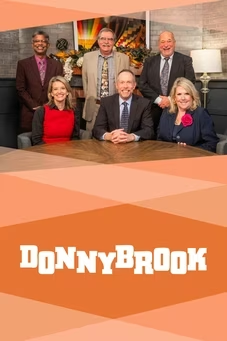
25 years after the Sept. 11 attacks, how do veterans who enlisted as a result of 9/11 feel about their decision to serve? We discuss the question with local veterans. They share why they decided to enlist, what they learned, what their service meant then, and what it means now.
Problems playing video? | Closed Captioning Feedback
Problems playing video? | Closed Captioning Feedback
Connections with Evan Dawson is a local public television program presented by WXXI
Connections with Evan Dawson
Inspired to serve by 9/11
9/14/2026 | 52m 5sVideo has Closed Captions
25 years after the Sept. 11 attacks, how do veterans who enlisted as a result of 9/11 feel about their decision to serve? We discuss the question with local veterans. They share why they decided to enlist, what they learned, what their service meant then, and what it means now.
Problems playing video? | Closed Captioning Feedback
Where to Watch Connections with Evan Dawson
Connections with Evan Dawson is available to stream on pbs.org and the PBS app.
Providing Support for PBS.org
Learn Moreabout PBS online sponsorshipFrom WXXI news.
This is Connections.
I'm Evan Dawson.
Today, as you know, marks 25 years since the nine over 11 terrorist attacks on America.
Our WXXI colleagues are covering various events and stories related to that day.
And here on Connections, we talked about, you know, what we wanted to do.
And I feel like what we're doing is a really good way to examine, the impact of that day and how it hit the country, what it was like then and what it inspired people to do.
We've invited service members who were either directly inspired to enlist after 911, or who felt the pull of service after that.
Due in part to the attacks.
The men and women enlisting after nine over 11 did not know exactly what they were signing up to do.
They did not know where they would go.
They only knew that they were compelled to wear the uniform.
And it is so easy to forget, I think.
For those who were alive and remember 911, how much public unity there was.
I know it didn't last all that long, but it is hard to imagine today what it was like in the weeks after.
And this hour, we're asking our guests what they think of their decision to serve.
Now, today, 25 years after nine over 11.
And let me welcome our guests in studio next to final.
Vic is back with us, a US Marine Corps veteran.
He's the director of under county veterans Services.
Nick, welcome back to the program.
Thanks, Evan.
Across the table.
Welcome back to Steve and Katie, a U.S.
Army veteran who served in Afghanistan.
Thank you for being here.
Thanks for having me.
Mike Kaposi, welcome.
U.S.
Army special forces veteran.
The veteran service officer with the Monroe County Veterans Services.
Welcome.
Thank you for being here.
Thank you.
My pleasure.
I'm going to ask all three of you to just describe when your service began.
And if nine over 11 played a role.
And I will start with you, Nick.
Yeah.
So it certainly did.
I was 18 at the time.
I was working for Coca Cola.
And I was in the back room of a Wegmans.
The Wegmans and, and, Pittsford and, the receiver had come back and said that a plane had hit one of the World Trade Center buildings, and this receiver was was very eccentric.
And so nobody really paid much attention to him.
And then he came back a little while later and said, another plane hit the other building of the World Trade Center, and our country's under attack.
And still I found it hard to believe him.
And then my phone or.
No, I got off.
So we had pagers back then.
Yeah.
My pager.
I got beeped and it was my boss at Coca-Cola.
And I went and called him and he said, Coca Cola is closing for the day.
The country was attacked and Coca-Cola's like the government, like they don't close.
It doesn't close for anything.
Yeah.
And I went home and I sat on my couch, and I watched over and over and over again my with my roommate, the planes hitting the towers.
And it was surreal.
It was hard to believe.
And then how I wound up in the Marine Corps.
I had never in my life thought about the military.
To be honest, I didn't even really know what the marine Corps was all about.
Two of my friends who I had been partying with at the time showed up and said, we're going to join the Marines.
You should come with us.
And I did it.
And I remember bringing the catalog home to my parents, and they were like, this is insane.
You've never had any idea to do this?
And then, ironically, the two friends that I joined with both became reservists.
So I didn't even see them again after I joined.
And then within eight months, I was in Afghanistan.
What would you have said at the time?
What did you say to your parents about why you were doing it?
I think I said to them, I don't have anything else going on.
That was it.
I don't remember at that moment having, like so many others describe as like this intense, feeling to get retribution or I want to get in the fight.
I don't remember having that.
I just remember thinking, I don't really know why I'm doing this, but I don't have anything else planned, and I'm going to go have an adventure.
And it wasn't until I got to Afghanistan that I recognized the meaning in that fight, and what role I was going to play in it.
How quickly do you feel like you changed?
Oh my God.
I can tell you the moment I changed, the moment I changed.
Was when I stepped off the, C-130 at Kabul, at the airport in Kabul, and we walked out of the front gates of the airport, and I looked around and saw a world that I could not have imagined existed.
And the very first thought that I had was in this world.
If one of these guys points an AK at me, there's no police to call.
I can't call my parents and tell them that I'm in trouble.
I am it.
And the Marines to my left and right are it.
And so if something bad happens and somebody wants to hurt me or try to kill me, I'm the only person that's going to be able to stop that and that I probably aged ten years in that moment.
You feel like you grew up real quick?
Yeah.
And did you know it?
If not on that day, in the weeks that followed, would you have been able to articulate why you were in Afghanistan?
I mean, why the country was there, why we decided to be there?
Yes, yes.
We had been very well prepared.
I remember when we were taken off from Cherry Point, a staff sergeant that was in, he was my platoon commander at the time.
Because we didn't have an officer, he was sitting by the Coca-Cola machine, ironically, and I went to get a Coke, and he called me over and he said.
He said, hey, boy, come over here.
How long have you been in the fleet?
And I said, about four months, staff sergeant.
He goes into something and you're going into combat.
You know how long I've been in the Marine Corps?
Like, oh, he's like 16 years.
And this is my first time going into combat two.
And then he went into a very expletive filled rant about how that was unfair and that he had to wait that long because he wanted to get.
Yeah, we all wanted to go.
There was none of us that didn't want to go.
We were excited to go.
My third deployment, maybe not as much excited to go.
How many total deployments did you have?
Three.
Yeah, three.
Yeah.
Okay.
And then at the time, again, no one knows how long these whether it's the war in Afghanistan, Iraq that followed or if there would be other engagements.
No one knew exactly what was coming.
Did you, over time, start to feel like you were part of a mission in a country that that mattered?
Did you eventually become?
I don't know if patriotic is the right word, more patriotic about it?
Yeah, I'm probably unique in this way.
I have a different thought.
Like, as I spent more time in Afghanistan, I stopped defining my service there by doing something to protect my country.
And I more started defining it by.
There are some really bad things happening to the people here.
And if I can do something that gives them some freedom, they're the ones that were really living under tyranny.
And it was insane how bad it was when I got there, which was I was, you know, it was a year after nine over 11.
And so to this day, I define all of my time in Afghanistan by it.
The proudest, thing about it for me is that I was a part of a mission that gave an entire generation the ability to vote for women, to go to school and to live free.
And it's a shame that that's no longer the case.
But at least we got a generation to be able to do that.
Across the table.
Stephen Cady, the floor is yours.
Tell me about nine over 11 for you.
And then tell me about your service.
So, on 911, I was in high school.
I was in, I believe, 10th grade.
My family has always had a, tradition of service.
Military services.
Especially, and my dad served my grandfather, his brother.
It goes way back.
And so it had been something I had considered.
I had also considered, careers in law enforcement.
You know, my father was a sheriff's deputy.
Things of that nature.
But I was not really set on anything.
911 happened, and it changed everything.
I decided pretty soon after what I wanted to go to, to college for, I went to Seton Hall University for, a degree in international relations and diplomacy.
And while there, I attended ROTC, the Reserve Officer Training Corps, which is one of the ways that you joined the military as an officer.
And the ROTC table, I think was like the first or second stop after I, like, got there, got moved into my dorm.
They had, like, a welcome, you know, welcome table from all the student organizations and everything, and, and, you know, I think I signed in and went straight to the ROTC table.
And, so, and I, I graduated high school in 2003.
I graduated college in 2007.
Commissioned as a second lieutenant, in the U.S.
Army.
I was branched armor.
So I was a I was actually a cavalry officer, which, you know, these days, there's no horses.
It's all trucks or, you know, heavy vehicles.
And, it was pretty ironic because I, I had chosen armor because I was like, oh, you know, why carry your weapon when your weapon can carry you?
And then I wound up in a very, very light, cavalry unit, where we walked everywhere.
And I got to my unit.
Knowing that we were deployed to Afghanistan.
So I got there in early 2008, and we deployed in May of 2009.
You know, it was.
I like I would echo what Nick said, like you trained for it and you kind of expect it, but it doesn't really hit you until you get there.
And we knew where we were going in Afghanistan, and it was kind of out on the on the edge.
It was, very, as we would say, kinetic environment.
Like there was a lot of fighting going on where we were, and so we knew what kind of environment we were going into.
And it's, it's funny that you mention that story about Kabul airport because I had something kind of similar.
I flew into Bagram, though.
And, you know, we were on the C-130, and it it, makes that combat landing that any veteran who's been in a combat landing knows what I'm talking about.
Where you think you're crashing because they don't brief you.
What's going on?
But the jet just kind of plummets toward the Earth to avoid, you know, any sort of fire.
And, you know, we we taxi in and we get off of the plane and, they said, okay, everybody line up.
And we all lined up there on the tarmac and they didn't tell us why.
And, you know, I'm grumbling and griping and I'm like, what are we doing standing here?
And then on the very same C-130 that we just got off on past the entire line of us, they brought on fallen soldiers, to take them home.
And it was a very big wake up call that that was like the first experience I had in country.
You know, and I would also echo what Nick said about the evolution of my service.
By the time I got to Afghanistan, like I said, it was 2009.
It was.
It was a little later.
And, you know, it did kind of feel at that point that we were past that initial, fervor.
I guess I would say.
And so getting there and seeing the conditions that people lived in, the slight progress that had been made and the, Room for help that we could provide.
You know, my unit oversaw the.
And we were a combat unit.
We oversaw the building of bridges and hydroelectric dams and roads and, and when you come home and you have lost friends and you have spent time, and you have seen and experienced things that were terrible, you search for meaning in that and the idea that we were able to help people go so far in the meaning making, because there are people, that, you know, I know today that we helped, and that means a lot, even if eventually it all had to come to an end.
Do you look back at your decision to serve with any kind of second guessing?
No, I don't, and, that's something I've given a lot of thought to.
I would do it all over again.
I would not.
I don't think I would change any of my decisions.
I think I used it as an opportunity to serve others.
And I think that we were able to do some good in the world.
And, of course, there's plenty of nuance there.
You know, like, I am not a cheerleader for war by any stretch of the imagination.
I think it should always be the course of last resort.
But, the fact that, you know, I was able to help send little girls to school.
The fact that we had, you know, relatively free and fair elections that we oversaw.
The fact that we were able to provide health care and clinics and roads and power to people who had never had any of that before.
And some type of governance that was invested in their welfare.
Was really, really special.
And I met a lot of wonderful people along the way.
And so and, you know, the military carried my family through a lot of hard times.
The military caused my family a lot of hard times, but it carried us to, and, you know, it has helped to, shape me into the person I am today.
Mike Capozzi, take us back to nine over 11.
Floor is yours.
Well, first off, let me say, thank you, Ivan, for having us here.
Allowing us to speak about September 11th, allowing us to remember that day, honor the victims, and the service members that sacrificed.
So I appreciate that.
September 11th was, infamous day for all of us.
My story is unique.
Interesting little turns and paths, but I, I was in college.
I was at University of Rhode Island.
I was an athlete there.
I was on scholarship my junior year, just the start of the year.
You know, the start of, you know, furthering your, academic, career and, you know, starting to kind of figure out my path in life and then September 11th happened and, I remember I was driving into to class one morning and I was listening to Howard Stern on the radio, and he was talking about and I thought it was one of those weird pranks that he was, you know, that he always did and the weird stuff.
But, when I got to class that, you know, it hit like a ton of bricks.
So we, we all knew right away kind of the gravity of the situation.
I think the whole country was in shock immediately following those events, we kind of all were looking and wondering what what the future holds for all of us.
I walked down about a week later to the recruiter's office.
I first went to the marine, recruiters office, and they just seemed to mean so.
I was like, I don't want to talk to these guys.
So then I walked down the road and, I went to the Army recruiter, and, I told him I wanted to go fight some bad guys, and that was kind of my, thought process was.
I just wanted to.
I just wanted to fight some bad guys.
And he said, well, what do you want to do?
And I said, well, I want to be a ranger because I don't know anything about anything.
I wasn't a military kid.
I didn't know a whole lot about the the armed forces at all.
And he said, well, I don't have any Ranger contracts, but I have a, a special forces contract.
And I said he showed me a five minute, video, looked really cool.
So I was like, yeah, I'll do that.
And, I called my mom later that night, and I said, I joined the Army.
And she said, whoa, whoa, whoa.
You're, you're in college.
You should graduate first.
You're on scholarship.
Like, you know, do that first.
So I went back, talked to the recruiter, and, ended up doing the delayed entry program, which allowed another year and a half for me to graduate.
So I didn't actually, I, I enlisted pretty much right away, but didn't actually go in until about two years after.
But you had time to consider and reconsider the decision.
Oh, absolutely.
And it didn't change.
No, it did not.
It I think it further cemented, further cemented my, my thought process.
And I think it actually gave me the time to understand my decision and why I made it and solidify the reason I did it.
After I, when I joined it was it was September 2003 was when I kicked off the basic training.
And, like I said, I did that Special Forces pipeline where they allow you to go to basic training and then send you right to the qualification course to see if you, the selection course first to see if you can get selected to try for the qualification course.
And, didn't really know what I signed up for.
During that time, Saddam was gone.
And I remember thinking, oh, no, I just signed up for five years and the war going to end before I get to even start training, you know?
Little did I know that that was, you know, 20 years later, we'd still be doing it.
But, yeah, I went through the, the training, which is grueling.
And again, I didn't know a whole lot about it.
I was just kind of just, going through it and, the about a year and a half worth of training I got assigned, I got, I got awarded my Green Beret and assigned to a team.
And we immediately just started training and, and deploying overseas, it's interesting because the that the two years like I had that delayed entry to year ish one year and a half, two year window and then I had training for a year and a half, or so.
And that is a lot of time to reflect and a lot of time to think.
And the entire time, you know, you're questioning yourself, you're wondering if the war is going to end.
I didn't want to be in the military to not deploy and go fight.
That was the whole reason I went there.
I knew I wasn't going to be a 20 year guy from the minute I signed up.
So during that time, I think watching the country unify and watching every, you know, walking down the street and seeing American flags on every house and, the feeling and it's hard to it's hard to describe to people who didn't experience it.
You know, for those of us who did, we know exactly what I'm talking about, that that powerful unity that our country had was my drive to to to continue through the training process.
The selection process is pretty grueling and, has like 90 something percent, washout rate.
And most people quit.
And I remember thinking to myself, thinking to firefighters running into the buildings and thinking, how the heck am I going to quit if these guys ran into the building trying to save people like I could never I could have never have quit.
So I knew I was never going to quit.
And, you know, that that attitude that, allowed me to get through the, the training course and eventually get earn my Green Beret and then, get assigned to a team.
How many deployments I did?
One combat deployment, one to Iraq.
I did a few other, country deployments, but, one Iraq combat deployment in the Army.
So the days after 911, you just said, I want to sign up and kill bad guys.
Two years later, you had felt the unity of the country, and you had the images of the firefighters, and the people would sacrifice themselves, and you felt compelled that it was a duty for you.
Would you have described it that way?
Yeah, it was almost, at the time I was in college and I had no, no purpose, no direction.
I really didn't know what I was going to be doing.
And when September 11th happened, it it put a highway for me to get on, and I knew exactly.
That's my path.
And I remember talking with my mom about it, and she said, I thought she was going to be, like, nervous or afraid.
And she was actually relieved.
She's like, finally this.
You know, he has a purpose, something to do.
And you look back now.
And how do you feel about your decision?
I think it was, one of the best decisions I could have made.
You know, I, I'm glad I didn't do any research before, because I probably would have talked myself out of it.
But I was.
I felt an overwhelming sense of of pride and, commitment to do it, and I I'm glad I did it.
I don't have any regrets.
In fact, I would do it again.
And I would recommend people do it to take a leap and try for it.
On that point, when we come back from this only break.
I want to talk to our guest, Mike Capozzi.
Steve and Katie.
Nick Stefanovic, all members of the American Service who in some way were affected enough by 911 to go serve this country and to do that at a time when they knew that their own lives could be in danger.
And certainly they were.
I mean, they served in combat.
They served the country.
But what I want to talk to them about is if the unity that Mike just described, which is not a fantasy, it was somewhat fleeting.
It didn't last.
Political division, of course, happens.
And did.
But the unity, you know what our guests maybe learned from feeling that.
And if that's ever achievable again, are we so divided that we couldn't do that?
And then beyond that, they've all described nine over 11 as an attack on the American homeland, which is what it was.
And it could have been significantly worse, if not for, incredible heroes on an another plane that went down in Pennsylvania.
So we know that that was an attack on the homeland.
This is not a country that gets attacked a lot of the homeland.
A lot of the war that we fight is elsewhere.
And so you can feel insulated from it.
You can feel like war is far away.
A war is not real.
There's not an existential threat to us.
And, you know, a lot of people smarter than me have written about what that means over the decades, which is people call it decadence, this idea that people just take for granted that everything will always be fine.
That you don't ever have to fight for it, or that wearing a uniform in some way was never needed in the first place.
And I want to talk to our guests about what they think about future service.
So we'll come back with Mike Capozzi, Stephen Cady, Nick Stefanovic, 25 years after nine over 11 and thanking them for their decision to serve and talking about their experience with it.
That's next.
Coming up in our second hour, we wrap up a week of conversations on music.
But the conversation with the hen house prowlers there, a band from Chicago, although one of the members has Finger Lakes roots, but they are also U.S.
musical ambassadors sanctioned by the United States State Department.
They've been to more than two dozen countries around the world, bringing music to try to break down barriers.
And they're going to perform some of what they perform around the world for us next hour.
Support for your public radio station comes from our members and from Mary Carey.
Yola center supporting residents to become active members of the community, from developing life skills to gaining independence.
Mary Carey, Yola Center Transforming Lives of people with disabilities.
More online at.
Mary Carey, ola.org and Excel is Blue Cross Blue Shield, providing members with options for in-person and virtual care, creating ways to connect to care when and where it's needed.
Learn more at Excel bcbs.com.
This is Connections.
I'm Evan Dawson.
It it really is easy, I think, to forget 25 years ago what the attacks of 911 did to galvanize an American spirit.
You got a president with a 91% approval rating in the days after nine over 11.
I mean, that's not going to happen today.
Probably even if there's another attack.
I. I don't want to be cynical about it, but I am curious to know what our guests think about that.
I mean, Nick, what do you remember feeling in terms of the unity of the country, and do you think that is achievable in any meaningful way?
Again?
So, you know, people had their criticisms of President Bush, being someone who served under President Bush.
I, we adored him when we were in the military.
And the reason we did so is because we watched him.
And it was very clear to us that he truly cared about what was happening and what was happening to us.
And I know that because I watched him get emotional about it a couple of times and we never doubted his, I mean, I never doubted, how genuine he was.
And I can remember the moment, which was will probably go down in history as one of the most convenient moments for a president when he stood on top of the rubble pile.
Yeah, yeah.
And the people were chanting, we can't hear you.
And he responded, pretty soon the people who knocked these buildings down are going to hear all of us pretty soon and was like, that was pretty cool for him to come up with in that moment.
And, and, you know, again, with the other political stuff and towards the end of it, I get that I think that our country has the ability has always had the ability to unify, with the exception of what this administration and I, I hesitate before I get into that too much.
But I think of what every other president has done before, how they've acted in moments of trauma and real challenge to this country and what they've sounded like, and forget all of the jargon, forget all of the key words and, and and that stuff.
If you just look at their faces like when President Obama talked about, but it was the Newtown shooting.
Yeah.
Oh, yeah.
You know, when President Bush would talk about, servicemembers being killed, going all the way back, I think, I don't know that we've ever had a president that didn't at one moment show how connected they were to real challenge in this country.
I just have never seen that with this president.
And I don't know if the country could unify behind that, but I 100% believe someone will come after him that will change that.
I think the country itself has the capacity to I hope that it never has to unify in that type of situation again.
And, you know, maybe it's a sad truth that that's the only way that happens again.
But yeah, I think America will always have the ability to come together.
But leadership is critical in allowing that to happen.
Stephen.
Katie, what do you think?
So, the the unity that we experienced, the national unity that we experienced after nine over 11?
I think there were parts of it that were beautiful.
There were parts of it that were necessary that were wonderful.
And we don't have anything like it these days.
I would also.
I would posit that there was a lot of harm that came out of it.
I think the country rallied together in a moment of darkness and pain, and I think that's a wonderful thing.
But I think that we allowed our fear and our anger to draw us to places that have had a serious negative impact on our country, in the world.
I'm in Iraq.
I'm talking about Iraq.
I'm talking about we have shifted in this country to and it was it was like this before 9/11.
But we have seen a huge shift even further to a foreign policy that is based entirely on militarism.
We don't look for diplomatic solutions anymore.
We look immediately to drone strikes, to Tomahawk missiles.
You know, the the global war on terror.
My deployments to Afghanistan are something that I'm very proud of.
I think that we allowed that, national unity and that.
Inability to speak counter to the prevailing opinions, to sweep us into situations that we should not have been swept into.
I do think Iraq is one of them.
You know, I mean, I think back to the restaurants, you know, after the invasion of Iraq, taking French fries off the menu and changing the name.
And I find it hard to believe that that's a sign of a healthy national psyche.
The global war on terror continues, right?
It's 25 years later.
We have, you know, been conducting operations in Libya, Kenya, you know, Somalia, Yemen.
We no longer attempt to work with other countries to solve problems.
We conduct illegal strikes on boats in the Caribbean.
We have launched an unconstitutional illegal war on Iran.
The global war on terror has cost us somewhere between 8 and $10 trillion, 7000 ballpark US service members have been killed.
Around 1500 Allied troops have been killed.
Estimates range up to a million civilians have been killed directly.
Up to 4.5 million people have been killed.
Indirectly, directly and indirectly.
I think it gave rise to the it was the foundation, the laying of the foundation of the surveillance state that we're starting to see come up, in the name of things like Homeland Security, in the name of things like safety, public safety.
We've seen militarization of police where police have, in the name of combating terrorism, gotten the hand-offs from the Department of Defense.
You know, they ride around in MRAPs and that kind of shoot first, ask questions later.
Attitude has permeated through our domestic policing as well.
You know, I think that it was a moment that unity was a moment of great potential.
And I think in a lot of ways, we rose up to meet it.
But I think in a lot of ways we let it sweep us away.
And so I am honestly a little wary of what might happen in similar circumstances today.
Just because I have seen the impacts Mike opposed.
What do you remember about the feelings after 911?
You talked a little bit about this already, but I want you to describe what you remember.
And then if you think it's achievable again.
Yeah.
So I do remember, how powerful that unity was and how, everyone it didn't matter what you looked like, who you were, where you lived.
We were all Americans.
We were all one, one unit.
One powerful unit.
That feeling of strength and unity, unmatched.
And I think it takes, unfortunately, a situation like that to reach that level.
I don't think we're going to wake up tomorrow and have that.
I am optimistic.
I do think that, you don't bet against America.
I think I think we can achieve whatever and anything and beyond what we know is possible.
I think America is the one place on earth that can do that.
I'm optimistic.
I don't think.
I don't think we're going to wake up tomorrow and be, you know, a happy country, that everyone loves each other all the time.
I don't think that's a realistic view, but I do feel that, in the event, of a situation, something happening, I feel like we could easily relive that, powerful unity.
It might not be my generation, but I do.
I do know, you don't bet against America.
You don't.
You don't think we can't do it.
And the people who do think we can't do it are proven wrong over and over again.
So let me ask all three of you.
I'll start with Mike.
Go back around across the panel here.
When it comes to your decision, you were all driven for different reasons, but there were some similar threads after 911.
And what moved you to serve?
And when a country experiences extended, I'm going to use a phrase that Stephen especially is going to yell at me for using this phrase.
When you are a perceived public view of an extended peace time.
And I say that because, you know, the vice president of United States said last week he doesn't even think the Iran war is a war.
There's a lot of Americans who are who would tell you that they haven't really felt like we've been at war.
Some of that is because most of the war that we fight isn't on our soil.
I think what 911 did was it was shocking to people to feel like Americans, especially American civilians, could die on our soil, which felt not only far away from the the rest of the world, but impenetrable in many ways, so that faraway nature of war.
Of course, we've been fighting and engaged in a lot of places.
Stephen mentioned some of them.
But when you have an existential threat, when you feel like the homeland is under attack, you're all moved in different ways that before it happened, your whole lives might have been different had it not been for 911.
What does it take?
Are you concerned like that, that the average American now thinks of war, is far away, and thinks of the value of service in uniform as something either antiquated, unnecessary, etc.?
What do you think?
Yeah, absolutely.
I, I do feel that, our view of war has changed because of the events post nine over 11.
Iraq and Afghanistan were undefined, winnable wars.
We my recommendation to anyone who's leading the country in making decisions for our military should be if we ever get involved in a situation, we need to have a clear line of this is when it ends.
And without that, we we enter this endless war cycle.
And I think back to like, our deployments.
I knew my exact deployment day, and I knew my exact day I was going to return.
Well, that's not how I viewed war prior to that.
Prior to that, I viewed war as we're going there until we win.
And once we win, will return home.
And it became such a, oh, I'm going to deploy again.
I'm, I'm next, you know, next to our next, next deployment.
And there wasn't a clear, defined line of this is how we win this war and we need to meet that goal.
And once we hit that goal, it's over.
And more as ugly as we all know.
So we need to clearly define the, the goal and also understand that it's not going to be pretty.
We shouldn't get involved if we are worried about how it looks or how it feels.
War is ugly.
And I, I just worry that we are entering the state of these endless wars because we don't have goals in mind.
And how to how to end those and get out of them and, and define our winning of that of that war.
What you think?
Yeah, I, I would agree on the idea that, American society in general at large, doesn't really feel the impacts very much.
And in a lot of ways, that's a good thing, right?
I don't want America to have to feel the impacts of war.
Right?
I don't want anyone to have to feel the impacts of war.
It is.
It's dirty, it's ugly, it's awful.
You know, and, I think America should strive to make it any engagement that we're in as clean and honorable as we can, because we are supposed to be the good guys.
But try as you might, people die in war, and a lot of times the wrong people die in war, and that's unavoidable, when you go to war.
And so we should go into conflicts with, an idea if we have to go into a conflict of what our objectives are, how we're going to achieve them, and when we're going to say no more, even if we can't meet those objectives.
You know, I think that we should consider long and hard the costs not just of war, but of the overall direction of our foreign policy, where, you know, people, the average American voter thinks we spend far too much on foreign aid when it's like a 10th of a percent of our budget.
Meanwhile, the the Department of Defense is and has for a very long time now been the biggest recipient of American tax dollars.
And I think the American public should be informed on the conflicts that we are currently engaged in, whether that be Iran or boat strikes, on alleged drug runners, or, you know, drone strikes in places like, you know, Kenya or Somalia or whatever it is.
Those things are being done in our name.
That is the duty and responsibility of a citizen in a democracy.
Is to be involved, to be informed, to know what's being done by your government in your name.
And the military is an extension of the government.
We always used to say we always used to hear.
And these guys would probably echo it.
You know, the military is not political.
We're apolitical.
I always hate hearing that because it's not true.
Right.
The military should be nonpartisan, but the military answers to the executive branch.
We are funded by the legislative branch, right?
We are an extension of American foreign policy.
I say we are.
I am not anymore, thankfully, but but I think that distinctions important nonpartisan right matter.
It does matter.
It's very an attempt to be as nonpartisan as possible.
Yes, but I think people should always keep in mind, and I think service members should keep in mind, because we get it drilled into us all the time that the military is supposed to be apolitical, but we are the the we are a political solution of Clausewitz himself.
You know, we study Clausewitz in the military all the time, right?
War is an extension of politics by other means.
And so it is an inherently political act, and the American public should treat it.
That way.
They should be informed, they should not try and wash their hands of it.
Right.
Whether you are the one carrying the rifle, whether you are the one pulling the trigger, whether you were the one pressing the button to drop the bomb, or whether you are the one that is casting the vote, you have responsibility in a democracy for everything that happens inside your government.
And this is certainly a government function.
You know, I think that the military and the government owes to the American public transparency, truthfulness, you know, and and like we said, I think they owe us honest strategy, honest, clear goals, clear goals.
And, you know, an honest assessment of this is too much.
We're done.
Now.
Nick Stefanovic, when it comes to attacks on the on the homeland, I take Stephens Point.
Hopefully we'll never see another one again.
25 years ago today felt surreal.
Probably the reason that you and Mike especially were doubting what you were hearing when you first were informed is because it is so hard to envision it.
We hadn't lived really through something like that, but of course it was real.
Do you think the longer we go without sort of homeland engagement that people feel that the need to serve is less, that there is, something detached about it?
Well, I don't think we're seeing that.
I think that people are joining the military.
My daughter's in the Navy.
She's in Japan right now, and, she's incredibly excited about it.
I do think that this country doesn't feel like it's at war unless we put boots on ground somewhere.
Yeah, yeah, and I think that has a lot to do with Iran right now.
We feel like we've got some planes that are dropping bombs from way up high, so we're invulnerable, and we're just going to, you know, hit them and that it's like some type of other campaign that doesn't really matter if if the white House announced that they were putting boots on the ground, everything would change.
Which is why they've been so adamant about saying they will not do that.
Which to me also seems like a just a wild thing to think about, that we're going to go to war with this country and we're going to take out their leadership.
We're going to take out their military.
But we're not going to put boots on the ground.
And it's like, what?
How do you draw that line when you decide you're going to go to war with another country?
How can we sit here and say, we're only going to go to war halfway with this country?
So that's problematic to me.
The other thing that becomes really problematic to me is that I can't help but feel like.
If I, as an American civilian, am wondering how much our engagement in combat with other countries depends on the ego of our leadership, that's also nothing I've ever worried about before.
You know, when when I hear our leaders go out and say that they're really upset about something that another leader said about them and that they're really going to pay, and they better be careful about what they like.
It sounds like I'm listening to, like, somebody in high school talking about a bully.
And our foreign policy should be much, much more complicated, than that.
But I for some reason, I don't think that that has extinguished the, the, the ability for our youth, to want to serve, and, you know, and my closest example of that is my daughter, you know, she, came by a recruiter's office by chance and learned about what it meant to put that uniform on.
And she's one of the proudest, most excited people that I know about it.
So I don't have a doubt that that we can rise to the occasion.
I just have a doubt about how that goes right now.
Let me ask all of you to spend about a minute to wrap up, and I will say on my social feeds this week, no surprise, it's videos of the planes hitting the towers.
But it's also, I have taken the time instead of just kind of scrolling past it.
Not dealing with it to watch.
I've watched different angles I have.
This morning I was reading an old New York Times piece from 2002 that chronicled the final phone calls the people made who were in the towers above where the planes hit and would never be rescued.
I read The Falling Man, the Esquire story about the people who jumped and made myself sort of sit with it again, because 25 years is a long time and you forget how truly visceral that feeling was.
It's not a pleasurable thing to do, but it felt necessary for me this week, especially preparing to talk to the three of you who have made sacrifices and have served this country.
What do you think people should do on a day like today to at least honor it the right way and keep memory alive?
But a minute, a piece here, Nick.
What do you think?
I just came from the unveiling of the new, First Responders Memorial in Highland Park.
I think it's important to build memorials and to teach people.
I like you, Evan.
Have watched some of those videos.
The thought that I get now when I watch those videos is, this is what differentiates us from the enemy.
You know, Stephen mentioned this, a little while ago when we're at war.
Yes.
There it is horrible.
There are innocent people that die.
But, it is my belief that America has never purposefully targeted innocent civilians to try to shift, targeted and killed innocent civilians, to try to win a political, battle.
And I recently read a book about Osama bin laden and his response to why target innocent civilians.
And his justification was there were no innocent civilians, that if people support the way that our government goes, that they deserved what they got.
And I just remind myself that that's what makes us different.
One minute.
Stephen Cady so, this is where I am going to kind of plug my day job, which is what I've been on your program to discuss before.
And Nick's familiar with this.
I currently work as the housing coordinator for a nonprofit here in Rochester called Keeping our Promise.
And what we do is to help relocate and support Afghan men and women and their families who worked alongside us in Afghanistan.
You know who we're told if you stand with us, we will stand with you, and who have largely been abandoned not only by the public at large, but by the US government.
These folks put their lives on the line, whether they were working as Afghan soldiers, interpreters, you know, anything as small as being a cleaner at a facility that was run by 20s by the US government or the Afghan government that we helped establish puts those folks in danger.
And so keeping our promise, helps to relocate them to the Rochester area helps to provide for their needs until they can get on their feet and join us as Americans moving forward.
And so I would urge everybody to look for opportunities like that to donate your time, your resources, your money to help someone else.
In the name of that, Mike, I think the easiest thing we can do, the most immediate thing we can do is, grab a loved one and talk to them about it.
September 11th.
Exactly what we're doing here.
On a more intimate, family, environment.
I'm going to talk to my kids tonight about it.
My wife and I had already, discussed this.
We're going to we're going to talk to our kids about it.
But we're not going to talk about our kids.
We're going to show them some stuff, limited, and we're going to tell them how we felt, and then we're going to ask them questions.
And I think that's probably the best thing, the most honorable thing we can do to honor, to honor that day, and all the events that that came after that day is just talk to them, specifically the younger generation, because they didn't experience what we experienced.
They don't know what we know 25 years ago today.
By the way, where's the memorial again?
Next to honor.
It's Highland Park.
It's right on the corner of, South Ave in Highland, next to Farnham, because the US marine Corps veteran, director of Monroe County Veterans Services.
Thank you, thank you.
Thanks for being here.
Stephen Cady, a U.S.
Army veteran who served in Afghanistan, keeping our promise as well.
Thank you very much.
Thank you.
Mike.
Suppose a U.S.
Army Special Forces veteran, veteran service Officer Whitman are kind of veteran services.
Thank you very much.
Thanks for having me.
To the three of these gentlemen and to everyone who decided to serve, for the various reasons, after that day, you have our respect and appreciation.
And we've got more Connections coming up.
I just want.
To be.
This program is a production of WXXI Public Radio.
The views expressed do not necessarily represent those of this station, its staff, management or underwriters.
The broadcast is meant for the private use of our audience.
Any rebroadcast or use in another medium without express written consent of WXXI is strictly prohibited.
Connections with Evan Dawson is available as a podcast.
Just click on the Connections link at WXXI news.org.
 New Episode
- News and Public Affairs

Top journalists deliver compelling original analysis of the hour's headlines.
 New Episode
- News and Public Affairs

Today's top journalists discuss Washington's current political events and public affairs.


 New Episode
 New Episode
 New Episode
 New Episode
 New Episode
 New Episode
 New Episode
Support for PBS provided by:
Connections with Evan Dawson is a local public television program presented by WXXI